What's inside the box

Read 10 real cards. 
Straight from the deck.

Rendered exactly as they'll arrive in the mail: 5 cards from Law & Business, 5 from General Building (B), front and back, word for word. No excerpts, no teasers.

Tap a card to flip it · Swipe for all 10

Law & Business · 5 samples of 142

General Building (B) · 5 samples of 177

Front · tap to enlarge
Fall 202601142
Exam Frequency

Business Organization & Licensing

Licensing Requirements

When a Contractor’s License Is Required

Fall 202651142
Exam Frequency

Employment

Wages & Hours

Overtime Rules

Fall 202670142
Exam Frequency

Insurance, Bonds, & Liens

Workers’ Compensation

Workers’ Comp Insurance, CSLB Certificate, & Notice Requirements

Fall 202679142
Exam Frequency

Insurance, Bonds, & Liens

Liens & Remedies

Mechanics’ Liens

Fall 2026106142
Exam Frequency

Contracts & Project Management

Payments & Collections

Down Payments on Home Improvement Contracts & Cancellation

Fall 202601177
Exam Frequency

Planning & Estimating

Scope of Work & Code Compliance

Building Permits & Certificates of Occupancy

Fall 202639177
Exam Frequency

Framing & Structural Components

Decks & Stairs

Handrail & Guardrail Requirements & Dimensions

Fall 202647177
Exam Frequency

Core Trades

Plumbing

Water Heater Clearances, Strapping, & Relief Valves

Fall 2026105177
Exam Frequency

Finish Trades

Windows & Skylights

Egress Windows & Safety Glazing

Fall 2026117177
Exam Frequency

Safety

Personnel Safety

Trench Protection, Egress, & Soil Slope

Back · tap to enlarge
Business Organization & Licensing

Licensing Requirements

When a Contractor’s License Is Required

01 / 142

A contractor’s license is required for any project over $1,000. A contractor may also need a local business license in the city or county where they work.

$1,000 threshold: a license is required once a job runs over $1,000

Whole contract price: the limit applies to the total combined price of labor and materials, not labor alone

No splitting: it is illegal to break one job into smaller contracts to stay under $1,000

Employees don’t need their own license: a worker under a contractor’s direction is covered by the contractor’s license

Business license: usually required by the city or county where the contractor works, separate from the state contractor’s license

Alarm installer exception: security alarm installers are licensed by the Bureau of Security and Investigative Services (BSIS), not the CSLB

Fire vs. security: a fire alarm is CSLB work under the C-10 classification; a security (burglar) alarm goes to BSIS

When to show proof of license: only when an inspector or other government official asks

A contractor does not have to display the license at all times, but must produce it on request during a jobsite visit

Exam Frequency

Exam Tip

A license is required once a job tops $1,000, and splitting a job to dodge that limit is illegal. Show the license only when an inspector or official asks; a worker employed by a contractor does not need their own license.

Notes
Employment

Wages & Hours

Overtime Rules

51 / 142

California pays overtime on a daily basis as well as a weekly one, and the two tiers can stack inside a single long shift. Double time comes only from long days or the seventh straight day, never from weekly hours alone.

Daily overtime: first 8 hours = regular rate

Over 8, up to 12: 1.5 times the regular rate (time-and-a-half)

Over 12 hours: 2 times the regular rate (double time)

Weekly overtime: over 40 hours in a week = 1.5 times the regular rate

There is no weekly double-time

Daily example: $15/hr; days of 8, 9, and 14 hours:

Day 1: 8 × $15 = $120

Day 2: 8 × $15 + 1 × $22.50 = $142.50

Day 3: 8 × $15 + 4 × $22.50 + 2 × $30 = $270 → total $532.50

Weekly example: $25/hr, 50 hours, no day over 12: 40 × $25 + 10 × $37.50 = $1,375

7th consecutive day worked: paid at 1.5x for first 8 hours, then 2x for every additional hour

Holiday pay: pay for a holiday not actually worked does not count as “hours worked” for overtime

Public works: overtime runs daily, after 8 hours per day (see Card 117)

Exam Frequency

Exam Tip

For questions where weekly total hours are given, everything over 40 is 1.5×. There is no weekly double time. If daily hours are given, add using the 8/12 thresholds, and remember the 7th straight day: 1.5× for the first 8, 2× after.

Notes
Insurance, Bonds, & Liens

Workers’ Compensation

Workers’ Comp Insurance, CSLB Certificate, & Notice Requirements

70 / 142

Workers’ compensation insurance provides medical care, benefits, and wages to employees who are injured or sick due to work. Employers must carry workers’ comp for employees and keep proof on file with the CSLB.

Employers must have and pay for coverage: coverage is required once a business has employees, and the employer pays the premiums

Employees cannot be required to pay their own premiums

Certificate on file with the CSLB: a current, valid Certificate of Workers’ Compensation Insurance (or self-insurance) must always be on file

Automatic suspension: a lapse in coverage suspends the CSLB license automatically

The 90-day rule: the CSLB accepts a workers’ comp insurance certificate within 90 days of when coverage starts, and reinstates the license retroactively

Reporting employees to the carrier: each employee must be reported to the workers’ comp insurance carrier when hired

Coverage begins at the time of employment, not after an injury occurs

Written notice to employees: a written notice about workers’ comp benefits goes to new employees by the end of their first pay period

Exam Frequency

Exam Tip

A lapse in workers’ comp suspends the license automatically. The 90-day rule saves it: a certificate received within 90 days of its effective date reinstates the license retroactively.

Notes
Insurance, Bonds, & Liens

Liens & Remedies

Mechanics’ Liens

79 / 142

A mechanics’ lien is a legal claim placed on a property to secure payment for labor, materials, or services provided by a contractor on that property. It gives contractors, subcontractors, and suppliers leverage to collect money owed by the homeowner: the owner cannot sell or refinance the property until the lien is resolved.

Mechanics’ lien: attaches to and encumbers the owner’s real property as security until the bill is paid

Who can file: prime contractor, subs, material suppliers, and laborers

Required elements: a mechanics’ lien must state:

1.Description: a legal description of the property that’s sufficient for identification (not just a street address)

2.Name & amount: of the property owner and the amount of the claim

3.Work done: the labor or materials furnished and who furnished them

Where to record: filed at the County Recorder’s office in the county where the property is located

Not available on public works: contractors working on public works projects cannot file a mechanics’ lien (because a lien cannot be placed on government property)

See Cards 80–83 on Mechanics’ Liens

Exam Frequency

Exam Tip

Mechanics’ liens apply only to private property. When the lien is filed with the county, all three required elements must be present, including a legal description rather than just a street address, or the lien can be invalidated.

Notes
Contracts & Project Management

Payments & Collections

Down Payments on Home Improvement Contracts & Cancellation

106 / 142

California law limits the amount a contractor can collect as a down payment on a home improvement contract before work begins. A down payment must be returned within 10 days if the contract is cancelled.

Down payment maximum: $1,000 or 10% of the price, whichever is less

This applies regardless of how large the contract is

Example: on a $4,700 contract: 10% = $470, which is less than $1,000, so the max down payment is $470

Example: on a $20,000 contract: 10% = $2,000, but $1,000 is less, so the max down payment is $1,000

Can a homeowner pay before work starts? Yes, but only as a down payment within the legal limits above

Verbal contracts under $500: legally binding

A verbal home improvement contract for under $500 is legally binding

Contract cancellation: down payment must be returned within 10 days

The contractor cannot cancel or change the terms without the customer’s consent

If a home improvement contract is canceled, the contractor must return payment within 10 days of receiving the notice of cancellation

Remember, it’s 3 days if it’s a home solicitation contract (see Card 102)

Exam Frequency

Exam Tip

The down payment cap is always the lesser of $1,000 or 10%. If a contract is cancelled, the contractor must return any payment received within 10 days.

Notes
Planning & Estimating

Scope of Work & Code Compliance

Building Permits & Certificates of Occupancy

01 / 177

A building permit authorizes most construction before it starts. A Certificate of Occupancy then clears the finished building for use.

When a permit is required:

Most building work: a permit is required to construct, alter, repair, move, or demolish a structure, to change its occupancy, or to install electrical, gas, mechanical, or plumbing systems

Common exemptions: no permit required for a fence under 7 feet, a detached accessory building under 120 square feet, or finish work like painting

Permit timing:

12 months to start: work must begin within 12 months of permit issuance

1 year lapse: a permit becomes invalid if work is suspended or abandoned for 1 year

Demolition permit authority:

State authority: for a building over 36 feet tall

Local building department: for a smaller one

Appealing a permit decision: if an inspector will not sign off, or a dispute arises on approved plans, appeal to the building department or a board of appeals

Certificate of Occupancy (C of O): required before a new or occupancy-changed building may be occupied

What it contains: 1) the permit number, 2) building address, 3) owner’s name, 4) building inspector’s name, and 5) use and occupancy

The contractor’s license number is not required

When a basement counts as a story (6 feet above grade plane): a basement counts toward total allowable area when the floor above it sits more than 6 feet above grade plane (ground level)

See Card #2: Code Authority, Conflicts, & Remodels

Exam Frequency

Exam Tip

A permit covers construction, demolition, occupancy change, and trade systems; small jobs like a fence under 7 feet are exempt. The C of O lists the permit number, address, owner, and occupancy, but never the license number.

Notes
Framing & Structural Components

Decks & Stairs

Handrail & Guardrail Requirements & Dimensions

39 / 177

Handrails give a graspable rail along a stair, and guardrails protect the open side of a raised surface. Both have set heights and opening limits keyed to safety.

Handrail requirements: for all handrails:

Height = 34 to 38 inches: above the tread nosing, for both residential and public stairs

Diameter = 1-1/4 to 2 inches: circular diameter is sized for secure grip

Wall clearance = at least 1-1/2 inches: the gap between the handrail and the wall, so a hand can fully grip

Public stair handrails: required for 4 or more risers, on at least one side of the flight

Handrail extensions: must run at least 12 inches past the top and bottom risers

Guardrail requirements: required when the drop is more than 30 inches

Often occurs with open sides of decks, balconies, stairs, and landings

Guardrail opening limits: measured by the largest sphere that can pass through:

Non-stair guard: 4 inches (keeps a child’s head from passing)

Stair guard: 4-3/8 inches (slightly looser for the stair angle)

See Card #38: Stair Riser & Tread Limits

Exam Frequency

Exam Tip

Handrails required when there are 4+ risers on public stairs. Height is 34 to 38 inches. A guardrail is required when the drop is more than 30 inches.

Notes
Core Trades

Plumbing

Water Heater Clearances, Strapping, & Relief Valves

47 / 177

A gas water heater must have room to vent and burn safely, be braced for earthquakes, and relieve excess pressure without obstruction. California sets specific rules for clearance, strapping, and the relief valve.

Clearances:

18 inches above the heater: atmospheric-vent water heaters need at least 18 inches from the top to the ceiling, for draft-hood operation and service access

18 inches above a garage floor: a fuel-burning heater’s ignition source must sit at least 18 inches up, because flammable vapors are heavier than air and pool near the floor

Seismic strapping:

Strap at the upper and lower third: secure the tank with two straps, one around the upper one-third and one around the lower one-third of the tank’s height, the lower strap at least 4 inches above the controls, to resist earthquake movement

Anchor straps into wall studs with proper fasteners; a roofing nail through drywall is not acceptable

Required valves and fittings:

Pressure-relief (T&P) valve must drain freely: pipe it down to a safe spot; it may never be capped or threaded shut, since that traps dangerous pressure

Cold-water shut-off valve: required so the heater can be isolated for service without shutting off the whole house

Backflow preventer not required: not a required component on the heater; system backflow protection is handled elsewhere (meter check valve or fixture air gaps)

R-12 is the minimum tank insulation: set by the energy code to cut standby heat loss (heat lost while no one draws hot water)

Exam Frequency

Exam Tip

Strap the tank at the upper and lower thirds into studs, and keep the T&P relief valve draining freely, never capped. 18 inches top clearance to ceiling; ignition source 18 inches above a garage floor.

Notes
Finish Trades

Windows & Skylights

Egress Windows & Safety Glazing

105 / 177

Bedrooms need an egress window sized for escape and rescue. Glass in places where someone could fall against it must be safety glazing. Habitable rooms also need minimum natural light and ventilation.

An emergency egress window needs 5.7 sq ft of net clear opening: plus a minimum height of 24 inches, width of 20 inches, and a sill no higher than 44 inches above the floor

Where required: egress windows are required in every bedroom (sleeping room) and basements

The opening must lead directly outside (to a yard, court, or public way)

Security bars on an egress window: must release from inside without a key or tool, so they can’t block escape

Habitable rooms need natural light and air:

Natural light (glazing): at least 8% of the floor area

Natural ventilation (openable window or vent): at least 4% of the floor area

Safety glazing is required where breakage is a hazard: “safety glazing” is the rule; “safety glass” is the rated glass that satisfies it

Within 24 inches of a door: along the same wall, where someone could fall against it

Low glass near a walkway: bottom under 18 in., top over 36 in., within 36 in. of foot traffic

Safety glass is rated by impact resistance: Category II is the higher rating (sliding doors, large panes); Category I is lower

Tempered glass: type of safety glass that is heat-treated so it crumbles into blunt pieces instead of sharp shards (laminated glass is another type)

The bug (permanent stamp): a corner etch listing maker, standard met, glazing type, and thickness

See Card #106: Window Energy Ratings, Flashing, & Sash

Exam Frequency

Exam Tip

An egress window needs 5.7 square feet of net clear opening, and safety glazing is required within 24 inches of a door.

Notes
Safety

Personnel Safety

Trench Protection, Egress, & Soil Slope

117 / 177

A trench that a worker enters can collapse without warning, so Cal/OSHA sets depth triggers for protection and escape. A protective system is required at 5 feet, and a ladder, ramp, or stairway at 4 feet.

5 feet or deeper triggers protection requirements:

Three accepted options: protect the walls by 1) shoring (bracing the walls), 2) sloping or benching (cutting the walls back to a safe angle), or 3) shielding (a trench box the worker stays inside)

A sign, fence, or dry soil is not acceptable protection

The 5-foot rule: a trench below 5 feet may go without a protective system only when a competent person examines the soil and site and finds no cave-in hazard

Type C soil slope: the least stable soil is cut back no steeper than 1-1/2:1 (34 degrees) for an excavation up to 20 feet deep

Spoil 2 feet back: excavated dirt is kept at least 2 feet from the trench edge, so it cannot roll back in

Guarded crossing: a walkway or bridge over an excavation more than 6 feet deep and 30 inches wide needs standard guardrails on both sides

Egress requirements at 4 feet or deeper: ladder, ramp, or stairway required

A ladder, ramp, or stairway is required in any trench 4 feet or deeper that workers enter

25-foot reach: no worker may be more than 25 feet of lateral travel from the nearest egress

Call 811 before digging: after notifying DigAlert (811/Underground Service Alert), utilities get 2 working days to mark their underground lines before digging

See Card #73: Soil Types, Drainage, & Foundation Assessment

Exam Frequency

Exam Tip

A trench 5 feet or deeper needs shoring, sloping/benching, or shielding; egress is required at 4 feet or deeper.

Notes
1 of 10

License Ladder · For ContractorsLicense Ladder · For Contractors

Real cards. Real code. Plain English.Real cards. Real code. Plain English.

Every card teaches one exam topic the way you'd want it on the job: the rule in plain English, the exact numbers, and an exam tip that flags how the test tries to trap you, all in under 2 minutes. These 10 are samples from the two decks, 319 cards in all. Every License Ladder order includes the Law & Business deck, study guides, and the app that finds what you're still learning; add the General Building (B) deck for the full set. All from $99. New to the process? Read the exam guide.

  • Indexed, numbered, and color-coded by topic, with an exam-frequency meter on every card so you drill what's actually tested.
  • Cross-referenced to the app, on phone or computer. Flag a card "Need Review" and the practice tests drill that exact topic until it sticks.
  • Real California rules, current for 2026: CSLB licensing law, Cal/OSHA, contracts and liens, with a notes column for your own jobsite shorthand.
  • Built for short bursts. Under 2 minutes per card. Ten cards while the concrete truck backs in.
Law & Business · 142 cards General Building (B) · 177 cards
License Ladder
From $99

Law & Business for $99, or add General Building for $50 more ($149 total).

One payment · no subscription · free shipping

Law & Business deck · 142 cards142 cardsIncluded
General Building (B) deck · 177 cards177 cardsAdd-on
Study guidesIncluded
Study app + practice testsIncluded

Pass guarantee. Follow the plan, hit a green readiness score, and if you don't pass, we refund what you paid. 30-day returns. Read the terms.

Marcus Delgado
Marcus Delgado · Law & Business · BakersfieldMarcus Delgado · Law & Business · Bakersfield

"I failed Law & Business on my first try. But drilling the flashcards and practice questions helped way more than a boring class. License Ladder helped me pass."

The wall

What contractors are saying.

Real customers across California, by trade and city.

"The test wording is what gets you. All of the following EXCEPT, always, never... the cards drill those traps until you see them coming a mile away. Nothing on exam day surprised me."

Andre WilsonLaw & Business · StocktonLaw & Business · Stockton
Verified

"Reprobé el examen dos veces estudiando por mi cuenta. Con las tarjetas por fin entendí las leyes de contratos, y el inglés sencillo me ayudó muchísimo. Pasé con puntos de sobra. 100% recomendado."

Luis HernándezLaw & Business · Santa AnaLaw & Business · Santa Ana
Verified

"I'm 34 and haven't studied for anything since high school. Paid for a classroom course years ago and got nothing out of it. But this just... worked? The app kept feeding me the stuff I got wrong until I got it right."
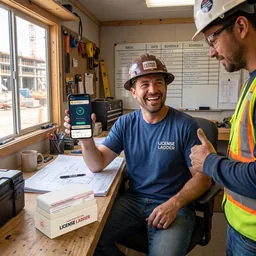
Mayra GonzalesLaw & Business · San JoseLaw & Business · San Jose
Verified

"I was skeptical at first. Flashcards sound like homework. But my readiness score went from low 40s to green in five weeks, and I finally passed both exams. Pulling my own permits now."

Samuel OkaforLaw & Business · Long BeachLaw & Business · Long Beach
Verified

"Honestly didn't think I had time for this. I run a framing crew, 50+ hours a week. Did the cards at lunch and in the truck. First try, done."

Tyler BrooksGeneral Building (B) · ModestoGeneral Building (B) · Modesto
Verified

"Two cards showed up on my exam nearly word for word: the down-payment limit and the mechanics lien one. That alone was worth the $149."

Brian FosterGeneral Building (B) · RiversideGeneral Building (B) · Riverside
Verified