
The CSLB exam, explained
The California Contractor License Exam. Now in plain English.
Updated September 22, 2026
Written by the License Ladder team · Reviewed by AJ Sokol, Co-Founder
 Try License Ladder for Free15 free cards in your browser. No credit card.Try freeTry License Ladder for Free15 free cards on the App StoreGet
Pass guarantee. Hit a green readiness score, and if you don't pass, we refund you.
You already know how to build. It's everything around the building that trips people up: who qualifies, what it costs, what the two exams really cover, and how to pass them without giving up your weekends. Read this once and you won't need another guide.
Jump to
Fees, timelines, and rules change. Always confirm the current figures at cslb.ca.gov before you count on them. We don't make numbers up.
From applicant to licensed, start to finish.
Six steps stand between you and your license number. Here's each one, straight and in the order you'll hit it.
Do I qualify for a California contractor's license?
You need four years of journey-level experience in your trade within the last 10 years, and you must be at least 18 with a valid Social Security number or ITIN.
How do I apply for the CSLB exam?
File the application for your classification, name a qualifier (the person whose experience and exam passes the license rests on, and who supervises the work: usually you, if you own the business and have the experience), and pay the $450 non-refundable application fee. You can apply online through CSLB's system or by mail.
How do I get approved to take the exam?
CSLB reviews your experience and eligibility. When it accepts your application, CSLB mails you a Notice to Schedule, and you book and pay for each exam directly with PSI, its testing vendor. Review typically takes a few weeks.
Which exams do I have to pass?
The Law & Business exam and your trade exam, booked separately, on the same day or on different days. This is the part License Ladder gets you ready for.
Do I need fingerprinting and an asbestos exam?
Complete Live Scan fingerprinting for your background check, and the short open-book asbestos exam every new applicant must complete before the license is issued.
What do I need to activate my license?
Post your $25,000 contractor bond, carry workers' comp if you'll have employees (some classifications need it either way, and nearly every active license will from January 1, 2028), and pay the initial license fee. Your number is issued and you're legal to work.
Source: Cal. Bus. & Prof. Code §7048 (as amended by AB 1170, effective January 1, 2026); CSLB Industry Bulletin #24-07, December 31, 2024, License Requirement for Minor Work Increases from $500 to $1,000.
Do you qualify to take the exam?
Before you spend a dollar, make sure you actually clear the bar. CSLB looks hardest at two things: your experience and your background.
How much experience do I need to qualify?
You need four full years of journey-level experience in the trade you're applying for, earned within the last 10 years. Journey-level means you worked at the skill level of a fully qualified worker, not an apprentice, so time as a journeyman, foreman, supervising employee, contractor, or owner-builder counts.
- Up to three years can come from approved schooling, an apprenticeship, or a related degree, but you still need real hands-on time.
- Your experience has to be certified by someone who saw the work: an employer, a licensed contractor, a foreman, a co-worker, or a building official.
- CSLB can ask for proof, so keep pay stubs, W-2s, tax records, and project addresses.
Do I need a background check?
Every applicant is fingerprinted through Live Scan, and CSLB runs a state and federal background check. A record doesn't automatically disqualify you, but it can slow things down or require explanation.
- You must be 18 or older with a Social Security number or ITIN.
- New applicants also complete a short, open-book asbestos exam as part of licensure.
- No personal trade experience? You can still qualify the business with a Responsible Managing Officer or Employee (RMO/RME) who has the experience. An RMO is an officer of your corporation or LLC; an RME is a permanent employee who works in the business at least 32 hours a week (or 80% of its operating hours). Either one becomes the license’s qualifier and takes the exams.
Cal. Bus. & Prof. Code §30 (Social Security number or ITIN); CSLB, Before Applying for a License (age 18; the open-book asbestos exam). Checked September 18, 2026.
Which classification should you apply for?
CSLB issues three main license classes, plus B-2 Residential Remodeling as a classification of its own. Apply for the one that matches the work you actually do, because your exam is built around that scope.
Big infrastructure: roads, pipelines, grading, and other specialized engineering work.
Structures using two or more unrelated trades. The most common general license. (B-2 covers residential remodeling.)
More than 40 specific trades, like C-10 Electrical and C-36 Plumbing. Pick the one that fits your craft.
What does it cost to get a contractor's license?
The license fee is the small part. Below is the full picture, from application to active license. Treat every figure as a starting estimate and confirm the current amounts with CSLB and your vendors before you budget.
Estimates only: bond premiums depend on your credit, workers' comp depends on payroll and trade, and CSLB and PSI set their own fees. Confirm every number before you budget.
Exam prep is a separate cost: see what classes, home-study courses and flashcards typically cost.
What's the difference between the bond and insurance?
The $25,000 bond protects your customers, not you. It's required to activate. Workers' comp is separate and only required once you have employees, though some classifications must carry it regardless.
Cal. Bus. & Prof. Code §7071.6 (bond); §7125 (workers' compensation)
LLC? Budget more
Licensing as an LLC adds a separate $100,000 worker bond, a fixed amount set by statute, plus a liability-insurance requirement. Sole owners avoid both.
Cal. Bus. & Prof. Code §7071.6.5 (bond); §7071.19 (liability insurance)
Is there fee relief for veterans?
California offers fee reductions and expedited processing for active-duty service members and veterans. Ask CSLB if you qualify.
What's actually on the CSLB exam?
Two multiple-choice exams. Half your license is the same for everyone: Law & Business. The other half is your trade.
Law & Business
Everyone takes this · Multiple choiceThe half that has nothing to do with swinging a hammer, and the half most people underestimate. It's contracts, money, employees, and safety law.
- Contracts, down-payment limits, and home-improvement rules
- Mechanics liens, bonds, and getting paid
- Employees, payroll, workers' comp, and licensing law
- Cal/OSHA safety, California's rules, not the federal ones
Your trade exam
Specific to your classification · Multiple choiceThis is the one you'd think is easy, until you hit the code questions and the trick wording. It tests the book version of the work you already do by feel.
- California code sections specific to your trade
- Materials, methods, and the math behind them
- Safety and procedure on the specific tasks you do
- Exact numbers, clearances, loads, slopes, ratings
How are the CSLB exams scored?
Both exams are multiple choice and graded on the spot. CSLB doesn't publish a fixed passing score, and the cutoff can vary, so aim high. You find out pass or fail before you leave the test center.
- A pass report shows that you passed, not your exact score.
- A fail report breaks down how you did by topic, so you know what to drill.
- Pass one and fail the other? You only retake the one you didn't pass.
The seven sections on the Law & Business exam.
Every applicant sits this one. CSLB: “All applicants must pass: 1) the law and business exam; and 2) a specific trade or certification exam in the classification applied for.” CSLB divides it into seven sections and publishes the approximate weight of each, so you can see where the questions are. Every section is tested, so don’t skip any.
Bidding · cost control · project organization · contracts · payments21%
Hiring employees · supervising and training employees · evaluation and record-keeping · payroll20%
Cash management · budget and planning · taxes · financial reporting15%
Training and reporting requirements · general safety · hazardous/unknown materials14%
Company organization · licensing requirements · advertising and subcontracting13%
Workers’ compensation insurance · business insurance · liens and other remedies12%
Prevailing wage requirements · bonding requirements · insurance requirements5%
The full Law & Business exam page takes each section apart: what it actually asks you to decide on the job, the references CSLB names for it, plus the time, the fee, what a passing and a failing score report show, who has to take the exam, and the narrow exceptions that can excuse it: a pass inside five years under §7065(d), and the waivers in §§7065.1 to 7065.3.
Section names, subtopics and weights come from CSLB’s Law and Business study guide, form 13E-LAW (03-2026), for examinations scheduled on or after December 1, 2021. CSLB marks the weights “*Percentages are approximate*”. PSI’s candidate bulletin prints the same seven sections with the same weights. The “all applicants” line is Get Licensed to Build, Q9. All checked 22 September 2026.
Stuck on a word like RME, stop payment notice or certified payroll? The plain-English glossary defines 32 of them, each with its statute.
SB 779: the minimum CSLB civil penalty for unlicensed contracting is now $1,500.
CSLB's minimum civil penalties changed on July 1, 2026, starting with the one for contracting without a license, a licensing rule from section 1. Here are the new figures, and how a civil penalty differs from a criminal fine.
A civil penalty is not a criminal fine. The $1,500 minimum is a civil penalty assessed by CSLB on an administrative citation its registrar issues. A criminal case is a separate matter: contracting without a license is a misdemeanor, and a first conviction is punishable by a fine of up to $5,000, up to six months in county jail, or both. SB 779 did not change those criminal penalties. A first conviction has no minimum fine; a repeat conviction carries a mandatory fine of at least $5,000, or 20% of the contract price if greater. Know which is which.
Sources: Cal. Bus. & Prof. Code §§7028 and 7099; §7028.7 as added by SB 779 (Archuleta), Ch. 233, Stats. 2025; §7099.2 as added by SB 291 (Grayson), Ch. 455, Stats. 2025, which carries SB 779's new minimums; both operative July 1, 2026; CSLB Industry Bulletin, New Laws Affecting Contractors Starting in 2026. Statute text checked September 21, 2026.
Trade-by-trade breakdown.
Each trade deck targets the topics that show up most on that classification's exam. License Ladder is launching with the General Building (B) deck; Residential Remodeling (B-2), Plumbing (C-36), and Electrical (C-10) are coming soon.
General Building B
Classification · broadest scopeThe widest license in the state, and the one most contractors reach for. A Class B lets you take on projects that involve at least two unrelated trades, framing, plumbing, electrical, finishes, and tie them together under one contract. It's also the biggest deck, because the exam can pull from a little of everything.
On the exam, expect heavy emphasis on project management, contracts, and scope: how you bid a job, schedule subs, handle change orders, and stay inside the building envelope and code. You don't need to be the expert in every trade, but you do need to know enough to run the job and keep it legal.
Heads-up: a B license is about coordinating trades. If your work is one specialty only, a C classification usually fits better.
Residential Remodeling B-2
Classification · existing homesThis deck is coming soon. We're building it now and launching with General Building (B). Get notified.
The newer remodeling-focused license, built for contractors who work on existing homes rather than ground-up builds. A B-2 covers improvements, repairs, and renovations that use at least three unrelated trades, think a kitchen or whole-home remodel, without the full Class B scope.
The exam leans on what's different about remodel work: tying new work into old construction, demo and disposal, dealing with what you find behind the walls, and the contract and disclosure rules that protect homeowners on improvement jobs. Expect the same Law & Business backbone as the B, applied to remodels.
Heads-up: the B-2 scope and trade-count rules are specific and have changed in recent years. What a B-2 can and cannot contract for.
Plumbing C-36
Classification · code, venting, fixturesThis deck is coming soon. We're building it now and launching with General Building (B). Get notified.
A specialty license for installing, repairing, and servicing plumbing systems: water supply, drain-waste-vent, gas, fixtures, and water heaters. If your day is pipe, fittings, and fixtures, this is your classification.
This exam is heavy on exact numbers, and those numbers are exactly what it likes to flip into trick questions. Drain slopes, vent sizing and distances, fixture-unit counts, backflow protection, and gas pressures all have specific code values you're expected to know cold. Get the units right and the trick questions get a lot easier.
Note: California plumbing rules can differ from the national model code. We teach the California version.
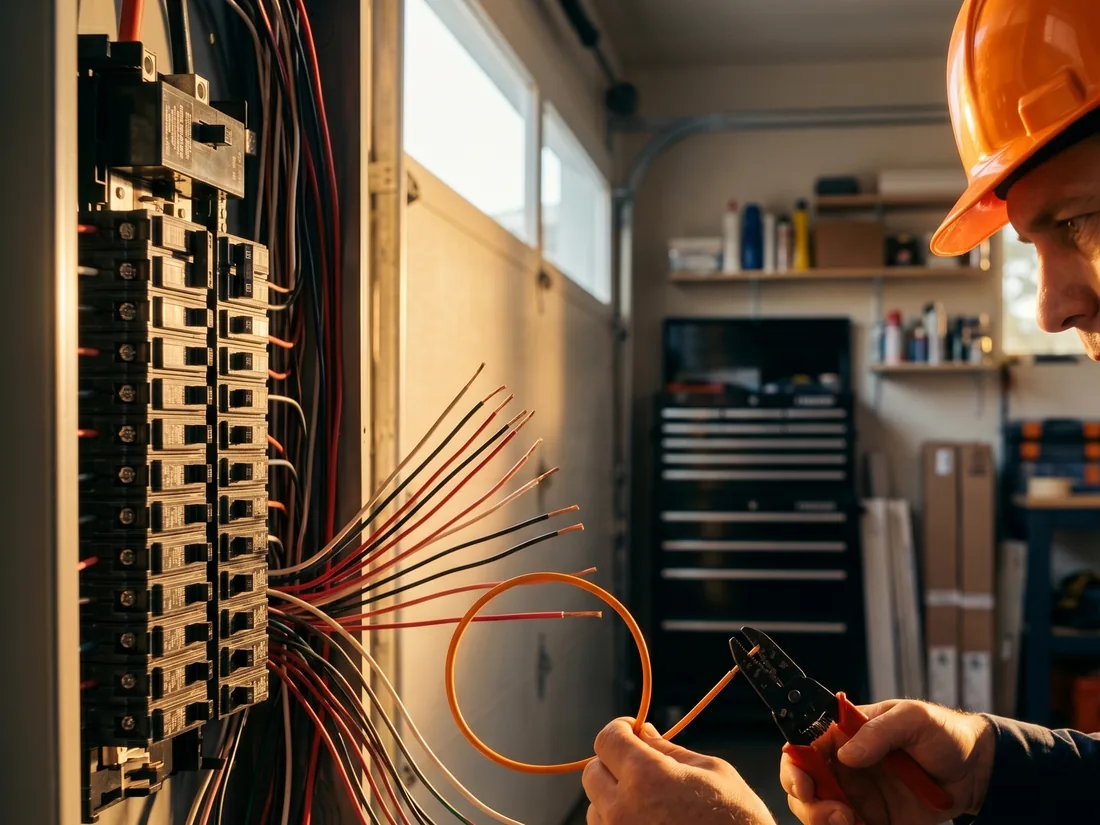
Electrical C-10
Classification · load calcs & codeThis deck is coming soon. We're building it now and launching with General Building (B). Get notified.
The specialty license for electrical work: wiring, services, panels, circuits, and fixtures for residential and commercial jobs. It's one of the most popular C classifications, and one of the most math-heavy exams.
Expect a lot of load calculations, conductor and conduit sizing, grounding and bonding, and code-table lookups. The math is unforgiving and the code is specific, which is exactly what flashcards and timed drills are built for. Knowing where a value comes from matters as much as the value itself.
Safety counts double here. Cal/OSHA and electrical-safety items show up on the exam and on the job.
What exam day actually looks like.
Walk in knowing exactly how the day runs, so the only thing on your mind is the questions in front of you.
Where do I take the CSLB exam?
You test at a PSI center on a computer. There are testing sites across California. You schedule and pay for each exam separately, and you can take them the same day or on different days.
What should I bring to the exam?
One valid, unexpired government photo ID: a U.S. driver's license or state ID card (any state), a passport (book or card; if it isn't a U.S. passport, confirm with PSI first), a green card, a U.S. military ID, or a U.S. Employment Authorization Card. The name on it must match the name on your application. The exam is closed book, no notes, no phone.
What's provided at the test center?
A calculator is provided, and CSLB says pencils, scratch paper and a scale ruler are available on request. Your own calculator is on PSI's prohibited list, so leave it at home. You won't get the code book, the numbers have to be in your head.
When do I get my exam results?
Because it's computer-based, you get a pass or fail report before you leave. No waiting weeks to find out.
What happens if I don't pass?
You can retake the failed exam after 21 calendar days, and you pay PSI's exam fee again. Use the topic breakdown on your fail report to focus.
How long is my exam approval valid?
Once approved, you generally have 18 months to pass both exams, and a passed exam stays valid for up to five years while you finish the other.
The full rules, from arrival time and accepted ID to what's banned from the room: Exam day at a PSI test center →
How long does it take to get a contractor's license?
From the day you send in your application to the day you can pull permits, plan on a few months. Here's how it usually goes. Yours will move faster or slower with CSLB's workload and how hard you study.
Weeks 0 to 1 · Apply
Gather your experience proof, complete the application, and submit it with the $450 fee.
After you file · CSLB review
CSLB reviews your eligibility. Once it accepts your application, it sends your Live Scan fingerprint packet and your Notice to Schedule. Online applications usually move faster than mailed ones.
Meanwhile · Study
This is the window to drill. Most people get exam-ready in a few weeks of short, daily sessions, so you're green before your test date arrives.
Schedule & test
Once approved, schedule each exam with PSI, on the same day or on different days. Results are immediate.
Final steps · Bond & activate
The asbestos exam, your bond, workers' comp or an exemption, and the license fee. Then CSLB issues your license number.
Bottom line: the studying is the part you control. How long CSLB takes is not, and it moves with the board's workload.
Want the real number? CSLB publishes which received-date each unit is working on, updated weekly, on its processing-times page. Check it there before you plan around a date; any figure published anywhere else, including here, would be stale by the time you read it.
What counts as journey-level experience?
The four-year rule is the easy part. What trips people up is documenting it on the Certification of Work Experience (form 13A-11).
The rule is four years of journey-level or higher experience in your classification, earned within the last ten years, and someone with direct knowledge of the work has to certify it on CSLB form 13A-11 under penalty of perjury. Owner-builder time counts toward General Building (B) only, and school or a finished apprenticeship can cover up to three of the four years. Veterans can add service during a national emergency to the ten-year window.
Who can certify your experience, what proof CSLB accepts, and what gets applications returned
Can you skip the CSLB exam? The waivers, decoded.
A handful of legal paths let you get licensed without sitting for the exam. They're narrow, most are discretionary, and most applicants don't qualify. But if one fits you, it saves months. Here's the honest map, statute by statute.
You already passed it (§7065)
If you personally passed the exams for the same classification (or served as the qualifier on a license in good standing for it) within the last five years, you can reapply without retesting. This is the “no-exam application” most reinstatements use.
The family-business waiver (§7065.1(b))
For an immediate family member of a licensee when the license is needed to keep the family business alive, typically after death or retirement. You must have been active in that business for five of the last seven years, and the license must have been in good standing that whole stretch. Same classification only, and you still file experience certifications.
Long-time personnel (§7065.1(a), (c))
Listed on CSLB's records as personnel of an active licensee for five of the past seven years in the classification? The registrar may waive your exam. Corporations and LLCs replacing a departed qualifier have a parallel path for a supervisor with five-of-seven tenure, but a company can only use it once every five years.
Adding a classification (§7065.3)
Already licensed and want a second classification without another exam? You need five-of-seven years as listed personnel, four years of journey-level work in the new trade, and the registrar must judge the new classification closely related to what you hold. CSLB audits at least 3% of these, so the experience must be real.
Moving from another state? Reciprocity covers five states (§7065.4)
California has contractor license reciprocity with five states: Arizona, Louisiana, Mississippi, Nevada and North Carolina. Utah is not on CSLB’s list (checked 22 September 2026). Reciprocity can waive the trade exam only; you still take California’s Law & Business exam unless you passed it within the last five years. Read the full reciprocity guide.
CSLB, General Reciprocity Information · BPC §7065.4
The first one is automatic: if you fit §7065, the law says no exam is required. Every other waiver above is discretionary: the registrar may grant it, not must. If your waiver is denied or you simply don't fit one, the exam is the path, and it's very passable with the right prep.
Fingerprinting, background checks, and past convictions.
Every applicant (and every officer, partner, and qualifier on the license) gets fingerprinted. For most people it's a 20-minute errand. Here's the process, the fees, and the truth about criminal records, which is fairer than most people expect.
The Live Scan errand
After your application posts, CSLB mails a packet with the DOJ Request for Live Scan Service (form BCII 8016). Take all three copies to any Live Scan site, get printed, and return your copy to CSLB within 90 days or the application can be voided. Clean prints usually clear the DOJ in 48 to 72 hours.
What it costs
$32 DOJ fee + $17 FBI fee + the site's own rolling fee (varies, often $20 to $40). Out of state? CSLB mails hard-copy fingerprint cards instead: rolled at any U.S. law-enforcement agency, $49 to CSLB, and plan on three to six months or longer of processing instead of days.
A record isn't a wall
You are not required to disclose convictions on the application. CSLB learns what it needs from the DOJ check. Denial is only allowed for convictions substantially related to contracting, generally within the last seven years. Dismissed and expunged convictions, arrests without conviction, and pardoned offenses can't be used against you at all.
AB 2138 rules; serious felonies, registrable sex offenses, and fiduciary financial crimes have no seven-year limit
B or B-2: which General Building license do you need?
California has two general-building licenses: the broad General Building (B), and the narrower Residential Remodeling (B-2), which covers improvements to existing residential wood-frame structures, needs three or more unrelated trades on every contract, and cannot contract for structural changes to load-bearing parts. The law's exact limits, the experience each license needs, what picking the wrong one costs, and both CSLB exam outlines are on our B vs B-2 decision page.
Which CSLB exams are offered in Spanish?
Ten of them. CSLB’s Examination FAQ says “Spanish versions of 10 exams commonly taken by candidates are available,” and names each one: Law and Business, B General Building, and the C-8 Concrete, C-9 Drywall, C-15 Flooring and Floor Covering, C-27 Landscaping, C-33 Painting and Decorating, C-36 Plumbing, C-39 Roofing and C-54 Ceramic and Mosaic Tile trade exams.
Both exams License Ladder covers are on that list. B-2 Residential Remodeling is not. If your exam has a Spanish version, a translator is not an alternative to it: CSLB says “candidates requesting translators for those exams are required to take the Spanish versions.” For every other trade exam and language, CSLB may let an approved translator you arrange sit with you. How translators and accommodations work.
Source: CSLB, Examinations Frequently Asked Questions. The list and both quotations checked September 22, 2026. CSLB can change the list at any time; if its page differs from this one when you read it, CSLB’s page governs.
What the General Building (B) exam actually tests, by the numbers.
CSLB doesn't publish question-level statistics. So we built our own: every one of the 153 topics in our General Building master deck carries an exam-yield rating from 1 (occasional) to 5 (highest), assigned from the printed deck's testing-frequency analysis and cross-linked to the app's General Building practice questions. Here's what that dataset says about where the points really are.
Where the exam concentrates
“High-yield” = rated 4 or 5 of 5. The takeaway: Safety is the second-biggest category but the lowest yield per topic, while Core Trades carries the exam: 48 topics, 27 of them high-yield.
Yield distribution across all 153 topics
43% of all topics rate high-yield (4 or 5). Study time should be even more lopsided than that, which is exactly how our app schedules it.
The 15 highest-yield topics on the B exam
The only topics rated 5 of 5 in our analysis. If you memorize nothing else, memorize these:
- Placing & finishing fresh concrete
- Rebar sizes, cover & placement
- Site preparation, fill & excavation
- Roofing materials & minimum slopes
- Service entrance, cable support & terminations
- Ohm's law, Watt's law & meter safety
- Headers, beams & cantilevers
- Rafter types, cuts & sizing
- Anchor bolts & hold-downs
- Three-coat stucco application & assembly
- Tile adhesives, substrates & cure times
- Hardwood flooring: types, acclimation & slab methods
- Drywall hanging & fastening
- Egress windows & safety glazing
- Ceiling heights, room sizes & attic access
Methodology: yield tiers come from the testing-frequency analysis printed on every card of our General Building deck, compiled from CSLB's official B study-guide outline and thousands of practice-exam data points, and re-checked each deck revision. This analysis covers the trade exam; the Law & Business exam has its own seven-section outline above.
Law & Business for $99, or add General Building (B) for $50 more ($149 total).
Study smart, not slow.
You don't have a free month. You have lunch breaks, drive time, and an hour after dinner. Here's how to use them.
Drill what you're still learning
Don't waste time rereading what you already know cold. The app keeps the cards you're still learning in heavy rotation and steers you straight at them, so every minute you put in moves the needle.
Learn trick patterns
Most wrong answers aren't a knowledge problem, they're a wording problem. "All of the following except," absolute words like always and never, two answers that look nearly identical. Enough practice questions and you'll spot the trap before it costs you.
Beat the clock
The clock fails more people than the material does. Start taking timed tests early so the pace feels routine by the time you sit the real thing. License Ladder builds that timing in for you.
Deciding between a class, a home-study course and flashcards? Compare the three prep formats, with typical prices.
Why do most people fail the CSLB exam?
Roughly half of unprepared applicants fail their first attempt. The reasons are predictable, which means they're avoidable.
They underestimate Law & Business
Skilled tradespeople clear the trade exam and get blindsided by contracts, liens, and payroll law. Half your license has nothing to do with your tools. Give it equal time.
They run out of time
They've never practiced under the clock, so they burn minutes on early questions and rush the end. Timed practice fixes this completely.
They fall for the trick wording
"Except," "always," "never," and two nearly identical answers cost easy points. Knowing the patterns is half the battle.
They guess at the numbers
Down-payment caps, lien deadlines, slopes, loads, and clearances are exact. "Close enough" is wrong on a multiple-choice exam. Memorize the figures cold.
Every one of these has the same fix: active recall and timed practice. That's what License Ladder is built around.
Already failed one? What to do next: the retake rules and how to study your score report.
The numbers worth memorizing.
The exam loves exact figures. These come up again and again across the Law & Business exam. Learn them cold.
Sources, checked September 18, 2026: Cal. Bus. & Prof. Code §7048 (the $1,000 threshold), §7159.5(a)(3) (down payment), §7071.6 ($25,000 bond), §7074 (18 months to pass both), §7065(d) (five-year exam waiver), §7140 (two-year renewal cycle); Unemployment Insurance Code §1088.5 (20-day new-hire report); CSLB, Before Applying for a License (age 18, four years of experience); 8 CCR §1716.2 (6 feet in residential framing; the general personal fall-arrest trigger in 8 CCR §1670 is 7.5 feet).
Every number on this list is on a card. Drill them until they're reflex.
Get License Ladder · from $99A few real cards, on the house.
Here's exactly what a License Ladder card looks like: the question worded the way the exam words it, the answer in plain English, and the one number that matters. Want to test yourself first? Take the free CSLB practice test, no login.
On a home-improvement contract, how much can you legally collect as a down payment?
The lesser of 10% of the contract price or $1,000, whichever is smaller. So even on a $90,000 remodel, your down payment is capped at $1,000. Exception: a contractor furnishing a performance and payment bond, lien and completion bond, or a registrar-approved bond equivalent or joint control covering full performance and payment is exempt from the cap.
What's the minimum slope for a horizontal drain pipe under 3 inches?
¼ inch of fall per foot. Less than that and waste won't clear; more is fine for small lines. California plumbing code sets this minimum so drains self-scour.
What's the standard general-lighting load for a dwelling?
3 volt-amperes per square foot. Multiply the square footage to size the service.
How long do you have to record a mechanics lien after completion?
A direct contractor records within 90 days of completion of the work of improvement (the whole project), or within 60 days of the owner recording a notice of completion or cessation, whichever comes first. Every claimant below the direct contractor gets the same 90 days, or 30 days after that notice, whichever comes first.
Cal. Civ. Code §8412, §8414
Watch for: "all of the following are required except…"
Read the except, the answer is the one that doesn't belong. The exam buries easy points in backwards wording.
You passed. Now what?
Passing is the hard part, but you're not licensed yet. A few steps still stand between you and a live license number.
How do I post my contractor bond?
File your $25,000 contractor bond with CSLB. A surety company issues it; your annual premium depends on your credit. This protects your customers and is required to activate.
Sort out workers' comp
If you'll have employees, you need workers' compensation insurance. A few classifications must carry it even with no employees. File the right form so CSLB can activate you.
Pay the license fee & activate
Pay the initial license fee ($200 sole owner, $350 otherwise). Once everything clears, your license number is issued and you're legal to contract and pull permits.
How do I keep my license active?
Renew your active license every two years, keep your bond and insurance current, and put your license number on all your construction contracts, your subcontracts and calls for bid, and every form of advertising, as the law requires.
Cal. Bus. & Prof. Code §7140 (two-year renewal); §7030.5 (license number on contracts and advertising)
Quick answers to common questions.
See the decks and guides
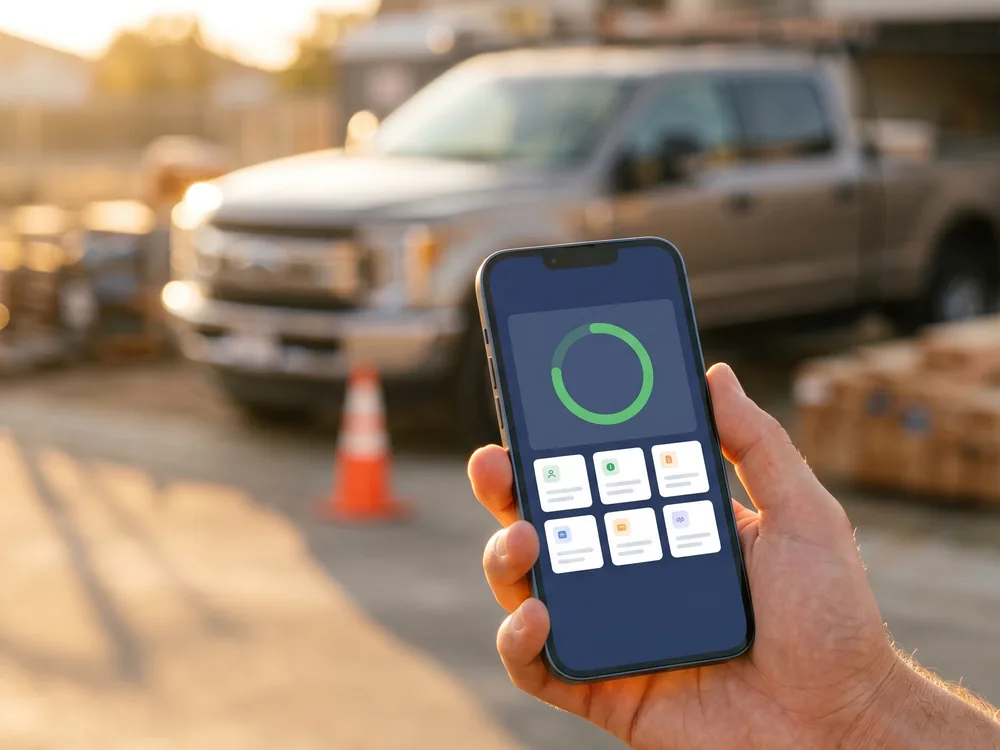
A closer look at the printed decks, the study guides, and the app in everyday use.
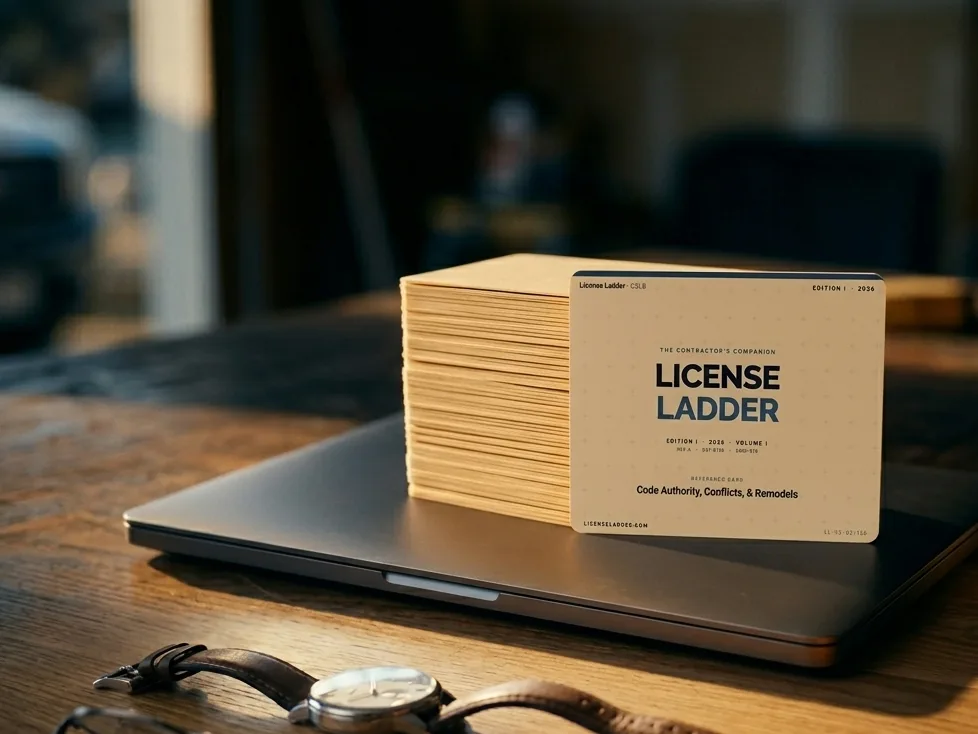
Study smarter, not harder. Pass the test in 1/2 the time.
The cards, the guides, and the app on your phone or laptop, built around the way people actually learn this material. From $99.
Law & Business for $99, or add General Building (B) for $50 more ($149 total).