The CSLB exam, explained

Learn about the CSLB Exam. Now in plain English.

Updated August 24, 2026

You already know how to build. It's everything around the building that trips people up: who qualifies, what it costs, what the two exams really cover, and how to pass them without giving up your weekends. Read this once and you won't need another guide.

2Exams, same day
~73%Score needed to pass
4Years of experience required
$1,000Job size that needs a license

Jump to

Step 01 · The path

From applicant to licensed, start to finish.

Six steps stand between you and your license number. Here's each one, straight and in the order you'll hit it.

1

Do I qualify for a California contractor's license?

You need four years of journey-level experience in your trade within the last 10 years, and you must be at least 18 with a valid Social Security number or ITIN.

2

How do I apply for the CSLB exam?

File the application for your classification, name a qualifier, and pay the $450 non-refundable application fee. You can apply online through CSLB's system or by mail.

3

How do I get approved to take the exam?

CSLB reviews your experience and eligibility. When you're approved, the testing vendor (PSI) sends you a notice to schedule. Review typically takes a few weeks.

4

Which exams do I have to pass?

Same day, back to back: the Law & Business exam and your trade exam. This is the part License Ladder gets you ready for.

5

Do I need fingerprinting and an asbestos exam?

Complete Live Scan fingerprinting for your background check, and the short open-book asbestos exam every new applicant must pass.

6

What do I need to activate my license?

Post your $25,000 contractor bond, carry workers' comp if you'll have employees, and pay the initial license fee. Your number is issued and you're legal to work.
$450
Application fee, non-refundable
4 yrs
Journey-level experience required
$200+
Initial license fee once you pass
$25k
Contractor bond required
You need a license for any job of $1,000 or more. In California, taking work where combined labor and materials reach $1,000 without a license is illegal, and you can't advertise as a contractor without one.
Filling out the CSLB contractor license application at a kitchen table
Step 02 · Eligibility

Do you qualify to take the exam?

Before you spend a dollar, make sure you actually clear the bar. CSLB looks hardest at two things: your experience and your background.

How much experience do I need to qualify?

You need four full years of journey-level experience in the trade you're applying for, earned within the last 10 years. Journey-level means you worked at the skill level of a fully-qualified worker, not an apprentice, so time as a journeyman, foreman, supervising employee, contractor, or owner-builder counts.

  • Up to three years can come from approved schooling, an apprenticeship, or a related degree, but you still need real hands-on time.
  • Your experience has to be certified by someone who saw the work: an employer, a licensed contractor, a foreman, a co-worker, or a building official.
  • CSLB can ask for proof, so keep pay stubs, W-2s, tax records, and project addresses.

Do I need a background check?

Every applicant is fingerprinted through Live Scan, and CSLB runs a state and federal background check. A record doesn't automatically disqualify you, but it can slow things down or require explanation.

  • You must be 18 or older with a Social Security number or ITIN.
  • New applicants also pass a short, open-book asbestos exam as part of licensure.
  • No personal trade experience? You can still qualify the business with a Responsible Managing Officer or Employee (RMO/RME) who has the experience.

Which classification should you apply for?

CSLB issues three license types. Apply for the one that matches the work you actually do, because your exam is built around that scope.

Class A · General Engineering

Big infrastructure: roads, pipelines, grading, and other specialized engineering work.

Class B · General Building

Structures using two or more unrelated trades. The most common general license. (B-2 covers residential remodeling.)

Class C · Specialty

More than 40 specific trades, like C-10 Electrical and C-36 Plumbing. Pick the one that fits your craft.

Step 03 · The real cost

What does it cost to get a contractor's license?

The license fee is the small part. Below is the full picture, from application to active license. Treat every figure as a starting estimate and confirm the current amounts with CSLB and your vendors before you budget.

Application fee (per classification, non-refundable)$450
Exam fee paid to PSI (per exam; two exams)~$46 each
Live Scan fingerprinting (plus rolling fee)~$49+
Initial license fee, sole owner$200
Initial license fee, corporation / partnership / LLC$350
$25,000 contractor bond (your annual cost, credit-dependent)~$75–$300/yr
Workers' comp insurance (only if you have employees)Varies
Typical all-in to get licensed~$800–$1,200

What's the difference between the bond and insurance?

The $25,000 bond protects your customers, not you. It's required to activate. Workers' comp is separate and only required once you have employees, though some classifications must carry it regardless.

LLC? Budget more

Licensing as an LLC adds a separate worker bond (often $100,000) and a liability-insurance requirement. Sole owners avoid both.

Is there fee relief for veterans?

California offers fee reductions and expedited processing for active-duty service members and veterans. Ask CSLB if you qualify.

Step 04 · The two exams

What's actually on the CSLB exam?

Two multiple-choice exams, same day, roughly 115 questions each. Half your license is the same for everyone: Law & Business. The other half is your trade.

Law & Business

Everyone takes this · ~115 questions

The half that has nothing to do with swinging a hammer, and the half most people underestimate. It's contracts, money, employees, and safety law.

  • Contracts, down-payment limits, and home-improvement rules
  • Mechanics liens, bonds, and getting paid
  • Employees, payroll, workers' comp, and licensing law
  • Cal/OSHA safety, California's rules, not the federal ones

Your trade exam

Specific to your classification · ~115 questions

This is the one you'd think is easy, until you hit the code questions and the trick wording. It tests the book version of the work you already do by feel.

  • California code sections specific to your trade
  • Materials, methods, and the math behind them
  • Safety and procedure on the specific tasks you do
  • Exact numbers, clearances, loads, slopes, ratings

How are the CSLB exams scored?

Both exams are multiple choice and graded on the spot. You generally need around 72–73% to pass, but CSLB doesn't publish a fixed cutoff and the number can vary, so aim well above it. You find out pass or fail before you leave the test center.

  • A pass report shows that you passed, not your exact score.
  • A fail report breaks down how you did by topic, so you know what to drill.
  • Pass one and fail the other? You only retake the one you missed.
Deep dive · Law & Business

The seven topics on the Law & Business exam.

This is the exam most tradespeople underestimate, and the one they fail most. It breaks into seven areas, and the questions are spread across all of them, so don't skip any.

1 · Business organization & licensing

Sole owner vs. corporation vs. LLC, qualifiers (RMO/RME), license types and classifications, and the rules for keeping a license active.

2 · Business finances

Bookkeeping basics, estimating and bidding, cash flow, taxes, and the simple math of running a profitable shop.

3 · Employment requirements

Hiring, payroll, withholding, the 20-day new-hire report, independent contractors, and labor law.

4 · Bonds & insurance

The $25,000 contractor bond, bonds of qualifying individuals, liability insurance, and when workers' comp is mandatory.

5 · Contract requirements

What must be in a home-improvement contract, the down-payment cap (10% or $1,000, whichever is less), cancellation rights, and change orders.

6 · Mechanics lien law

Preliminary notices, deadlines to record a lien, releases, and how contractors and subs actually get paid.

7 · Safety & public works

Cal/OSHA requirements, jobsite safety, injury and illness prevention, and the prevailing-wage and certified-payroll rules that apply on public projects.

Step 05 · Pick your path

Trade-by-trade breakdown.

Each trade deck targets the topics that show up most on that classification's exam. Card counts are illustrative until our bank is final. License Ladder is launching with the General Building (B) deck; Residential Remodeling (B-2), Plumbing (C-36), and Electrical (C-10) are coming soon.

General Building B

Classification · broadest scope
Available now

The widest license in the state, and the one most contractors reach for. A Class B lets you take on projects that involve at least two unrelated trades, framing, plumbing, electrical, finishes, and tie them together under one contract. It's also the biggest deck, because the exam can pull from a little of everything.

On the exam, expect heavy emphasis on project management, contracts, and scope: how you bid a job, schedule subs, handle change orders, and stay inside the building envelope and code. You don't need to be the expert in every trade, but you do need to know enough to run the job and keep it legal.

Project scopeCoordinating subsBuilding envelopeContracts & change ordersEstimatingCode overview
A general building contractor with blueprints at a framed jobsite
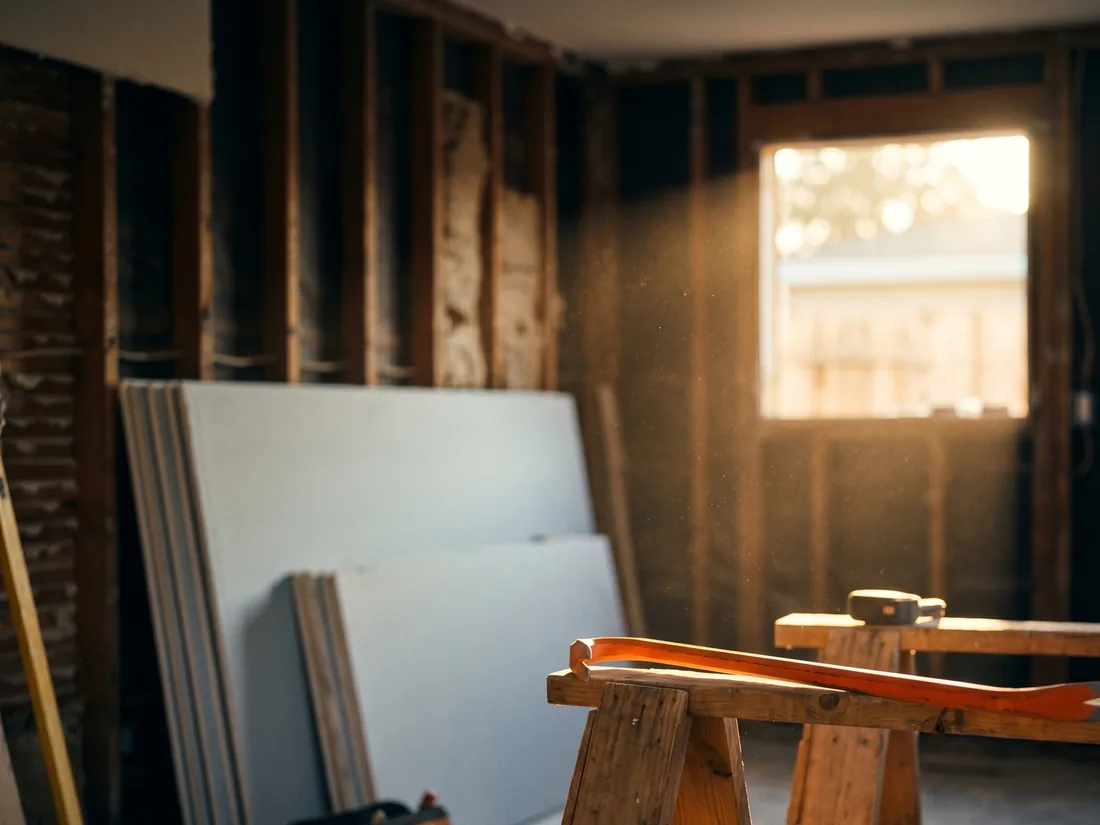
A residential remodel in progress, framing exposed

Residential Remodeling B-2

Classification · existing homes
Coming Soon

The newer remodeling-focused license, built for contractors who work on existing homes rather than ground-up builds. A B-2 covers improvements, repairs, and renovations that use at least three unrelated trades, think a kitchen or whole-home remodel, without the full Class B scope.

The exam leans on what's different about remodel work: tying new work into old construction, demo and disposal, dealing with what you find behind the walls, and the contract and disclosure rules that protect homeowners on improvement jobs. Expect the same Law & Business backbone as the B, applied to remodels.

Existing structuresMulti-trade remodelsDemo & disposalHome-improvement contractsHomeowner disclosures

Plumbing C-36

Classification · code, venting, fixtures
Coming Soon

A specialty license for installing, repairing, and servicing plumbing systems: water supply, drain-waste-vent, gas, fixtures, and water heaters. If your day is pipe, fittings, and fixtures, this is your classification.

This exam is heavy on exact numbers, and those numbers are exactly what it likes to flip into trick questions. Drain slopes, vent sizing and distances, fixture-unit counts, backflow protection, and gas pressures all have specific code values you're expected to know cold. Get the units right and the trick questions get a lot easier.

Drain slopesVenting & distancesBackflowPipe & fixture sizingGas & water heaters
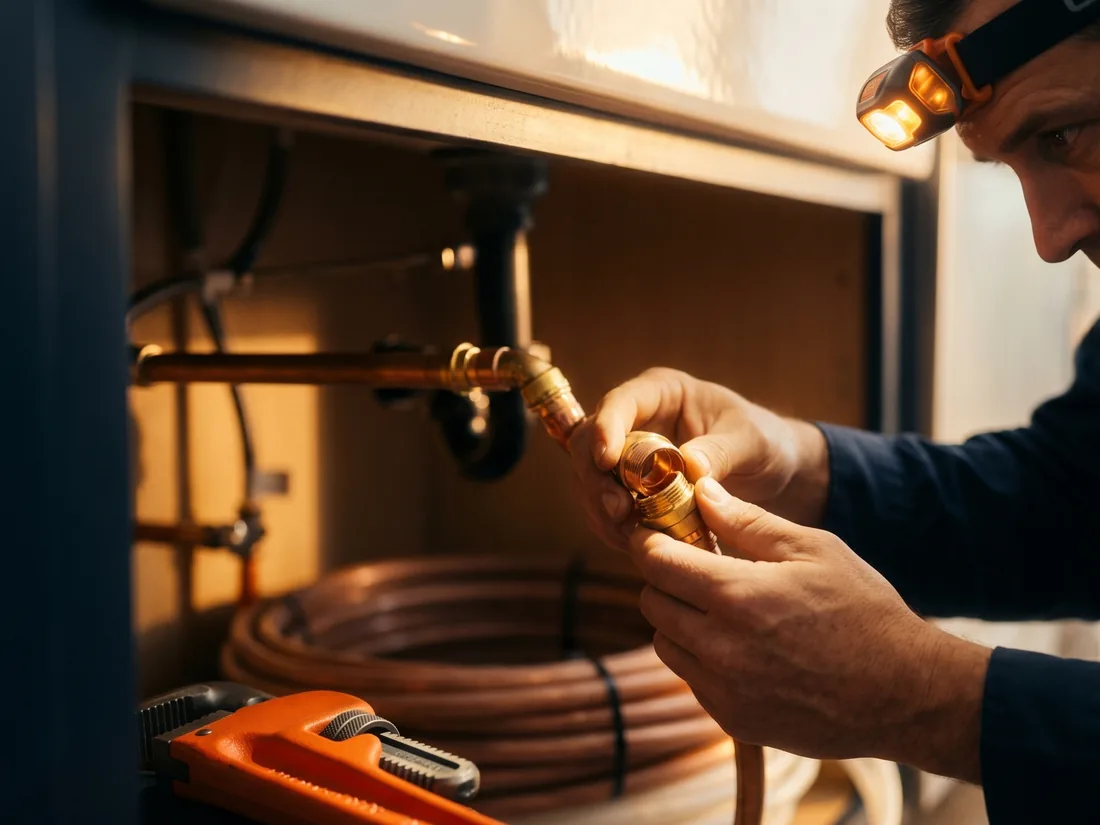
A plumber fitting copper pipe under a sink
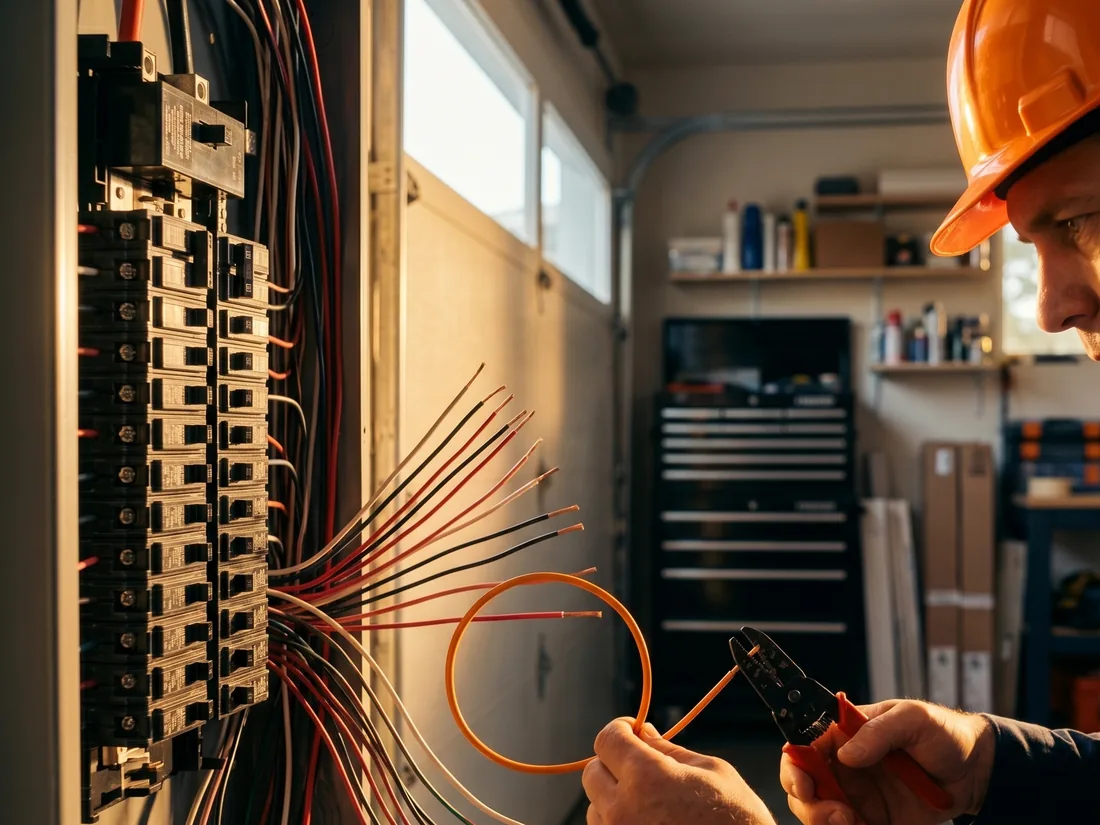
An electrician wiring an open breaker panel

Electrical C-10

Classification · load calcs & code
Coming Soon

The specialty license for electrical work: wiring, services, panels, circuits, and fixtures for residential and commercial jobs. It's one of the most popular C classifications, and one of the most math-heavy exams.

Expect a lot of load calculations, conductor and conduit sizing, grounding and bonding, and code-table lookups. The math is unforgiving and the code is specific, which is exactly what flashcards and timed drills are built for. Knowing where a value comes from matters as much as the value itself.

Load calcsConductor sizingGrounding & bondingConduit fillCode tables
Step 06 · Test day

What exam day actually looks like.

Walk in knowing exactly how the day runs, so the only thing on your mind is the questions in front of you.

Where do I take the CSLB exam?

You test at a PSI center on a computer. There are testing sites across California. Both exams are taken the same day, one after the other.

What should I bring to the exam?

A valid government photo ID that matches your application name, and your scheduling notice. That's it. The exam is closed book, no notes, no phone.

What's provided at the test center?

An on-screen calculator and scratch material are provided, so you don't need to bring your own. You won't get the code book, the numbers have to be in your head.

When do I get my exam results?

Because it's computer-based, you get a pass or fail report before you leave. No waiting weeks to find out.

What happens if I don't pass?

You can retake the failed exam after a short waiting period (about 21 days), with a retake fee. Use the topic breakdown on your fail report to focus.

How long is my exam approval valid?

Once approved, you generally have 18 months to pass both exams, and a passed exam stays valid for up to five years while you finish the other.

How long it takes

How long does it take to get a contractor's license?

From the day you send in your application to the day you can pull permits, plan on a few months. Here's how it usually goes. Yours will move faster or slower with CSLB's workload and how hard you study.

1

Weeks 0–1 · Apply

Gather your experience proof, complete the application, and submit it with the $450 fee.

2

Weeks 2–8 · CSLB review

CSLB reviews your eligibility. Online applications usually move faster than mailed ones.

3

Meanwhile · Study

This is the window to drill. Most people get exam-ready in a few weeks of short, daily sessions, so you're green before your test date arrives.

4

Schedule & test

Once approved, schedule with PSI and sit both exams the same day. Results are immediate.

5

Final steps · Bond & activate

Fingerprinting, the asbestos exam, your bond, and the license fee. Then your number is issued, often within a couple of weeks of passing.

CSLB says nearly half of all applications get sent back for being incomplete or inaccurate — blank fields, missing signatures, or experience forms that don't document the full four years. A returned application must be corrected within 90 days or it's void. And once accepted, you have 18 months to pass both exams before the whole application expires. Source: CSLB, Application Returned for Correction
The paperwork · Experience

What counts as journey-level experience?

The rule is four years of journeyman-level-or-higher experience in your classification, earned within the last ten years. What trips people up is documenting it. Here's how CSLB actually evaluates the Certification of Work Experience (form 13A-11).

Which roles count toward the four years?

Time as a journeyman, foreman or supervisor, contractor (licensed here or out of state), self-employed tradesperson, or owner-builder (B classification, on your own property) all qualifies. Part-time work is prorated — six years at half-time counts as three. Completing an apprenticeship program makes you a journeyman outright.

Who can sign off on your experience?

Someone with firsthand knowledge of your work: an employer, a licensed contractor, your foreman or supervisor, a fellow journeyman, a union rep — even a building inspector, architect, or engineer who observed the jobs. They certify under penalty of perjury, so “my buddy will vouch” is a felony-grade shortcut. No strikeouts, no photocopied signatures, no pencil.

Can school replace experience?

Partially. An A.A. in building or construction management is worth up to 1.5 years; a four-year degree in fields like business or architecture up to 2 years; apprenticeship completion or a construction-related bachelor's up to 3 years — the hard cap. At least one year must be hands-on. Sealed official transcripts required.

What if CSLB audits your application?

A random 3% of applications get their experience verified against payroll-grade records: W-2s, 1099s, tax transcripts, permits, contracts with client contacts, invoices, even canceled checks. Self-employed? Keep Schedule C filings and job paperwork. If your four years can't survive a paper audit, fix that before you file — not after.

The paperwork · Waivers

Can you skip the CSLB exam? The waivers, decoded.

A handful of legal paths let you get licensed without sitting for the exam. They're narrow, they're discretionary, and most applicants don't qualify — but if one fits you, it saves months. Here's the honest map, statute by statute.

You already passed it (§7065)

If you personally passed the exams for the same classification — or served as the qualifier on a license in good standing for it — within the last five years, you can reapply without retesting. This is the “no-exam application” most reinstatements use.

The family-business waiver (§7065.1(b))

For an immediate family member of a licensee when the license is needed to keep the family business alive — typically after death or retirement. You must have been active in that business for five of the last seven years, and the license must have been in good standing that whole stretch. Same classification only, and you still file experience certifications.

Long-time personnel (§7065.1(a), (c))

Listed on CSLB's records as personnel of an active licensee for five of the past seven years in the classification? The registrar may waive your exam. Corporations and LLCs replacing a departed qualifier have a parallel path for a supervisor with five-of-seven tenure — but a company can only use it once every five years.

Adding a classification (§7065.3)

Already licensed and want a second classification without another exam? You need five-of-seven years as listed personnel, four years of journey-level work in the new trade, and the registrar must judge the new classification closely related to what you hold. CSLB audits at least 3% of these, so the experience must be real.

Moving from another state? Reciprocity is narrower than you've heard (§7065.4)

California currently has reciprocity agreements with exactly five states: Arizona, Louisiana, Mississippi, Nevada, and North Carolina — not Utah, despite what older articles say. Your license must be active and in good standing for the previous five years, in a classification on CSLB's reciprocal list. And here's the part everyone misses: reciprocity only waives the trade exam. You still sit for California's Law & Business exam — the half License Ladder drills hardest. Holders of the NASCLA Commercial General Builders exam can request a trade-exam waiver the same way.

The paperwork · Background check

Fingerprinting, background checks, and past convictions.

Every applicant — and every officer, partner, and qualifier on the license — gets fingerprinted. For most people it's a 20-minute errand. Here's the process, the fees, and the truth about criminal records, which is fairer than most people expect.

The Live Scan errand

After your application posts, CSLB mails a packet with the DOJ Request for Live Scan Service (form BCII 8016). Take all three copies to any Live Scan site, get printed, and return your copy to CSLB within 90 days or the application can be voided. Clean prints usually clear the DOJ in 48–72 hours.

What it costs

$32 DOJ fee + $17 FBI fee + the site's own rolling fee (varies, often $20–$40). Out of state? CSLB mails hard-copy fingerprint cards instead — rolled at any U.S. law-enforcement agency, $49 to CSLB, and plan on three to six months of processing instead of days.

A record isn't a wall

You are not required to disclose convictions on the application — CSLB learns what it needs from the DOJ check. Denial is only allowed for convictions substantially related to contracting, generally within the last seven years. Dismissed and expunged convictions, arrests without conviction, and pardoned offenses can't be used against you at all.

The paperwork · Classification

B or B-2: which General Building license do you need?

Since 2021 California has had two general-building classifications, and picking the wrong one wastes an application fee. The short version: B builds and alters structures; B-2 remodels the inside of existing homes without touching structure.

Class B — General Building

The full classification: framing and rough carpentry, structural work, new construction, additions, and any project involving two or more unrelated trades. Its trade exam is the one our 153-topic analysis below is built for. If your work ever touches footings, foundations, load-bearing walls, or roof structure — this is your license.

Class B-2 — Residential Remodeling

For improvements to existing wood-frame homes using three or more unrelated trades on one contract. You can swap fixtures — faucets, toilets, outlets, ceiling fans, HVAC grills — but you cannot alter load-bearing elements or install or extend electrical, plumbing, or mechanical systems without the right C-class specialist. Experience path: four years of journey-level work across three-plus trades on residential remodels. It has its own trade exam (Planning & Estimating 15%, Core Trades Remodeling 25%, Finish Trades 18%, Exterior 13%, Job Site Prep 13%, Safety 16%).

Original data · Updated August 2026

What the General Building (B) exam actually tests, by the numbers.

CSLB doesn't publish question-level statistics. So we built our own: every one of the 153 topics in our General Building master deck carries an exam-yield rating from 1 (occasional) to 5 (highest), assigned from the printed deck's testing-frequency analysis and cross-linked to 1,419 practice questions. Here's what that dataset says about where the points really are.

Where the exam concentrates

Core Trades · 48 topicsavg yield 3.5 · 27 high-yield
Finish Trades · 27 topicsavg 3.4 · 14 high-yield
Framing & Structural · 21 topicsavg 3.4 · 9 high-yield
Planning & Estimating · 18 topicsavg 2.9 · 6 high-yield
Safety · 39 topicsavg 2.6 · 10 high-yield

Yield distribution across all 153 topics

HIGHEST
15
VERY HIGH
51
HIGH
43
MEDIUM
31
OCCASIONAL
13

The 15 highest-yield topics on the B exam

The only topics rated 5 of 5 in our analysis. If you memorize nothing else, memorize these:

  1. Placing & finishing fresh concrete
  2. Rebar sizes, cover & placement
  3. Site preparation, fill & excavation
  4. Roofing materials & minimum slopes
  5. Service entrance, cable support & terminations
  6. Ohm's law, Watt's law & meter safety
  7. Headers, beams & cantilevers
  8. Rafter types, cuts & sizing
  9. Anchor bolts & hold-downs
  10. Three-coat stucco application & assembly
  11. Tile adhesives, substrates & cure times
  12. Hardwood flooring — types, acclimation & slab methods
  13. Drywall hanging & fastening
  14. Egress windows & safety glazing
  15. Ceiling heights, room sizes & attic access
Compared honestly · Prices checked August 2026

Every way to prep for the CSLB exam, compared.

Full disclosure: we sell the $149 bundle on this list, so read accordingly — but every option below is real, linked, and priced from its own public site so you can verify. There was no honest comparison anywhere on the internet, so we wrote one.

OptionWhat you getPriceBest if…
CSLB official study guidesThe state's own outline of every exam section, in English and SpanishFreeEveryone — start here no matter what else you buy
Contractor-Prep1,400+ free online practice questions and an exam simulatorFreeYou want zero-cost question volume and will organize the studying yourself
License Ladder (that's us)319 printed flashcards with exam-yield ratings, printed guides, adaptive app with 1,400+ linked questions, pass guarantee$149 one-timeYou study in stolen moments — the truck, the lunch break — and want the yield analysis done for you
Contractors Intelligence SchoolApp-based courses (about $150 per course) up to a full program around $600~$150–$600You want a structured school-style program delivered through an app
Contractors License GuruPrep from ~$320 plus application-filing services from an ex-CSLB insider~$320+You want someone to handle the paperwork for you, not just the exam
Peerless InstitutePer-classification practice exams and bundles from the oldest school in the niche$120–$375You want classification-specific practice exams for a C-class trade
CSLS / Make Me A ContractorHome study to live online classes and an all-inclusive package, 40+ years running$295–$1,195You learn best with a live instructor and a classroom structure
Step 07 · How to study

Study smart, not slow.

You don't have a free month. You have lunch breaks, drive time, and an hour after dinner. Here's how to use them.

A

Drill your weak spots

Don't waste time rereading what you already know cold. The app keeps the cards you miss in heavy rotation and steers you straight at your weak spots, so every minute you put in moves the needle.

B

Learn trick patterns

Most missed questions aren't a knowledge problem, they're a wording problem. "All of the following except," absolute words like always and never, two answers that look nearly identical. Enough practice questions and you'll spot the trap before it costs you. 

C

Beat the clock 

The clock fails more people than the material does. Start taking timed tests early so the pace feels routine by the time you sit the real thing. License Ladder builds that timing in for you. 

Learn from their mistakes

Why do most people fail the CSLB exam?

Roughly half of unprepared applicants fail their first attempt. The reasons are predictable, which means they're avoidable.

They underestimate Law & Business

Skilled tradespeople breeze past the trade exam and get blindsided by contracts, liens, and payroll law. Half your license has nothing to do with your tools. Give it equal time.

They run out of time

They've never practiced under the clock, so they burn minutes on early questions and rush the end. Timed practice fixes this completely.

They miss the trick wording

"Except," "always," "never," and two nearly identical answers cost easy points. Knowing the patterns is half the battle.

They guess at the numbers

Down-payment caps, lien deadlines, slopes, loads, and clearances are exact. "Close enough" is wrong on a multiple-choice exam. Memorize the figures cold.

Cheat sheet

The numbers worth memorizing.

The exam loves exact figures. These come up again and again across the Law & Business exam. Learn them cold.

License required at this job size (labor + materials)$1,000
Home-improvement down payment cap (whichever is less)10% or $1,000
Contractor bond amount$25,000
Report a new employee to the state within20 days
Years of journey-level experience required4 years
Minimum age to hold a license18
Window to pass both exams after approval18 months
Passed-exam validity while finishing the other5 years
Active license renewal cycleEvery 2 years
Cal/OSHA fall-protection trigger height6 feet

Every number on this list is on a card. Drill them until they're reflex.

Get License Ladder · $149
Try before you buy

A few real cards, on the house.

Here's exactly what a License Ladder card looks like: the question worded the way the exam words it, the answer in plain English, and the one number that matters.

Law & Business · Contracts

On a home-improvement contract, how much can you legally collect as a down payment?

The lesser of 10% of the contract price or $1,000, whichever is smaller. So even on a $90,000 remodel, your down payment is capped at $1,000.

Cal. Bus. & Prof. Code §7159 · Tap to reveal
Plumbing · Venting

What's the minimum slope for a horizontal drain pipe under 3 inches?

¼ inch of fall per foot. Less than that and waste won't clear; more is fine for small lines. California plumbing code sets this minimum so drains self-scour.

Tap to reveal · Swipe to navigate
Electrical · Load calc

What's the standard general-lighting load for a dwelling?

3 volt-amperes per square foot. Multiply the square footage to size the service.

Law & Business · Liens

How long do you have to record a mechanics lien after completion?

Generally within 90 days of completion, sooner if a notice of completion is filed.

Test tactics · Trick wording

Watch for: "all of the following are required except…"

Read the except, the answer is the one that doesn't belong. The exam buries easy points in backwards wording.

The finish line

You passed. Now what?

Passing is the hard part, but you're not licensed yet. A few steps still stand between you and a live license number.

How do I post my contractor bond?

File your $25,000 contractor bond with CSLB. A surety company issues it; your annual premium depends on your credit. This protects your customers and is required to activate.

Sort out workers' comp

If you'll have employees, you need workers' compensation insurance. A few classifications must carry it even with no employees. File the right form so CSLB can activate you.

Pay the license fee & activate

Pay the initial license fee ($200 sole owner, $350 otherwise). Once everything clears, your license number is issued and you're legal to contract and pull permits.

How do I keep my license active?

Renew your active license every two years, keep your bond and insurance current, and put your license number on your contracts, ads, and trucks as the law requires.

Fast answers

Quick answers to common questions.

No. Every new qualifier passes both the Law & Business exam and a trade exam, unless you already hold a license and qualify for a waiver.
No. You can license as a sole owner, a partnership, a corporation, or an LLC. Sole owner is the simplest and cheapest to set up and activate.
No. Both exams are closed book. You can't bring notes or the code book, which is why the numbers have to live in your head before test day. A calculator is provided on screen.
There's no hard cap, but you wait about 21 days between attempts, pay a fee each time, and must pass within your 18-month window before the application expires.
No. CSLB and PSI handle your application and scheduling. We handle the part in between, getting you ready to walk in and pass. More questions →
The materials

See the decks and guides

A closer look at the printed decks, the study guides, and the app in everyday use.

A stack of License Ladder flashcards on a workbench
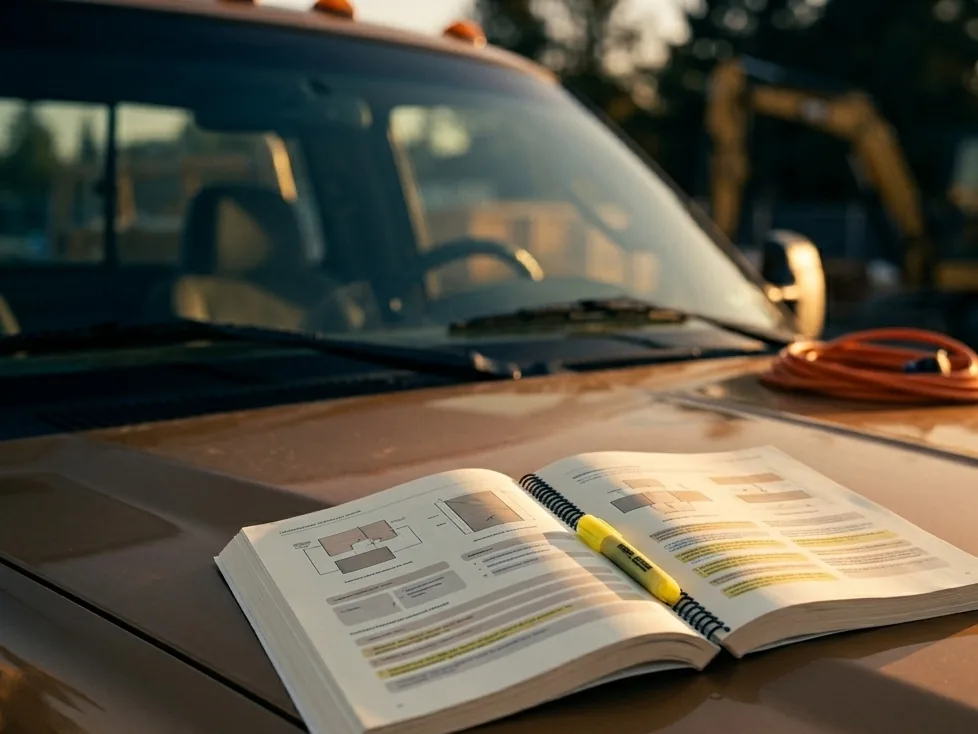
An open License Ladder study guide on a truck hood
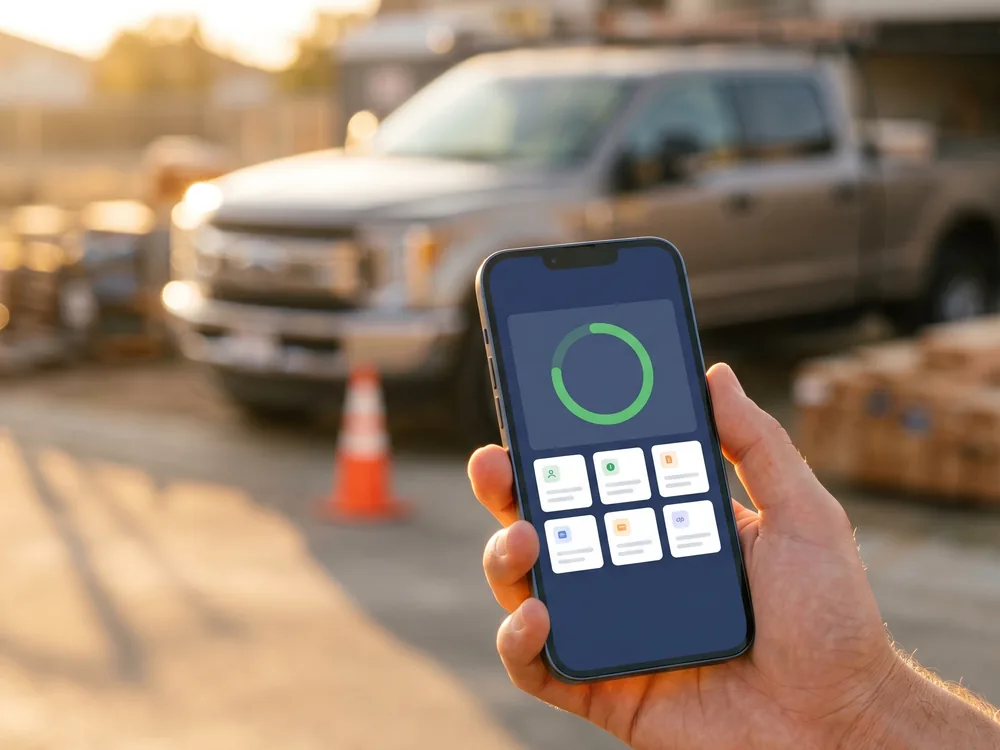
The License Ladder app showing the readiness score on a jobsite
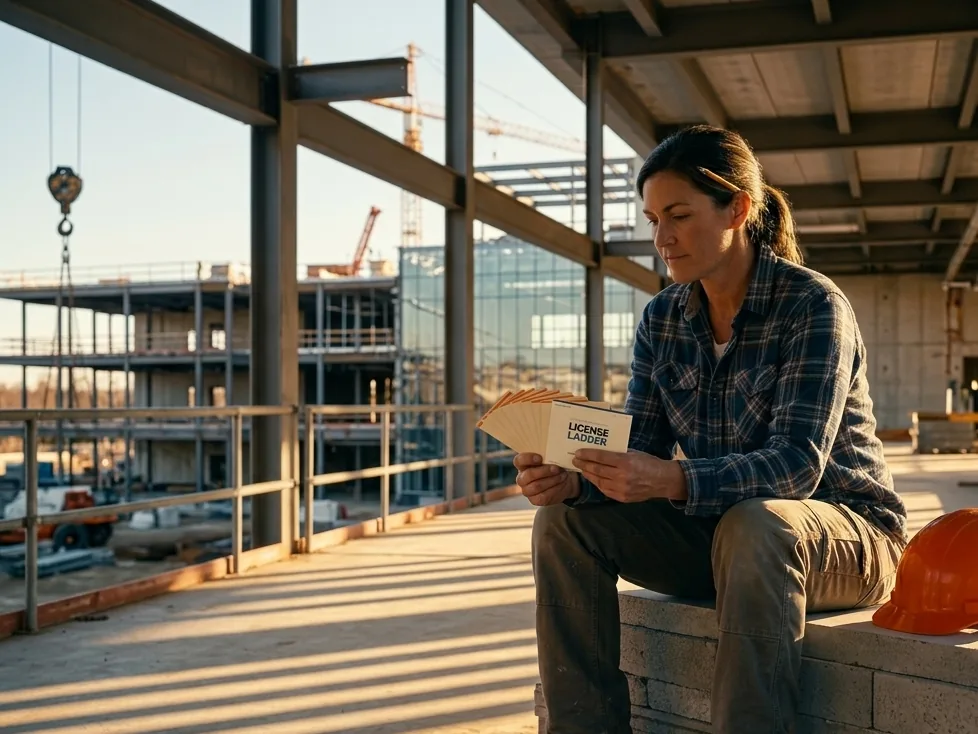
A contractor studying License Ladder cards on a construction site
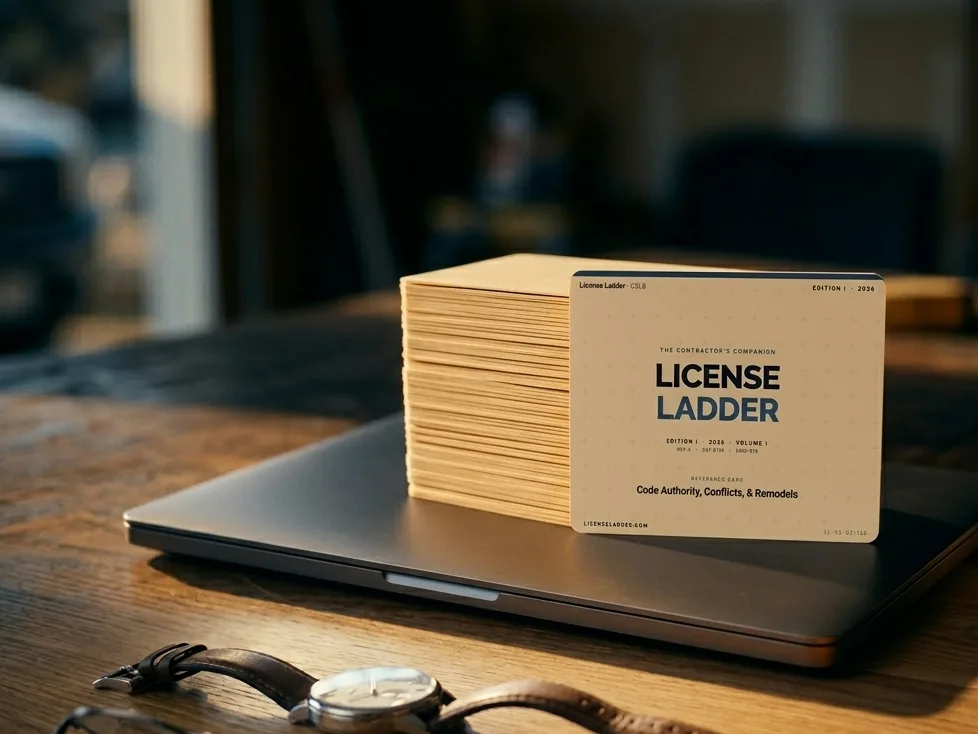
License Ladder flashcards and a laptop set up for a study session
A contractor celebrating his passing exam result outside the test center

Study smarter, not harder. Pass the test in 1/2 the time.

The cards, the guides, and the app on your phone or laptop, built around the way people actually learn this material. One bundle, $149, about a fifth of what the old exam schools charge.

$249$149 · full bundle
Lock in $149